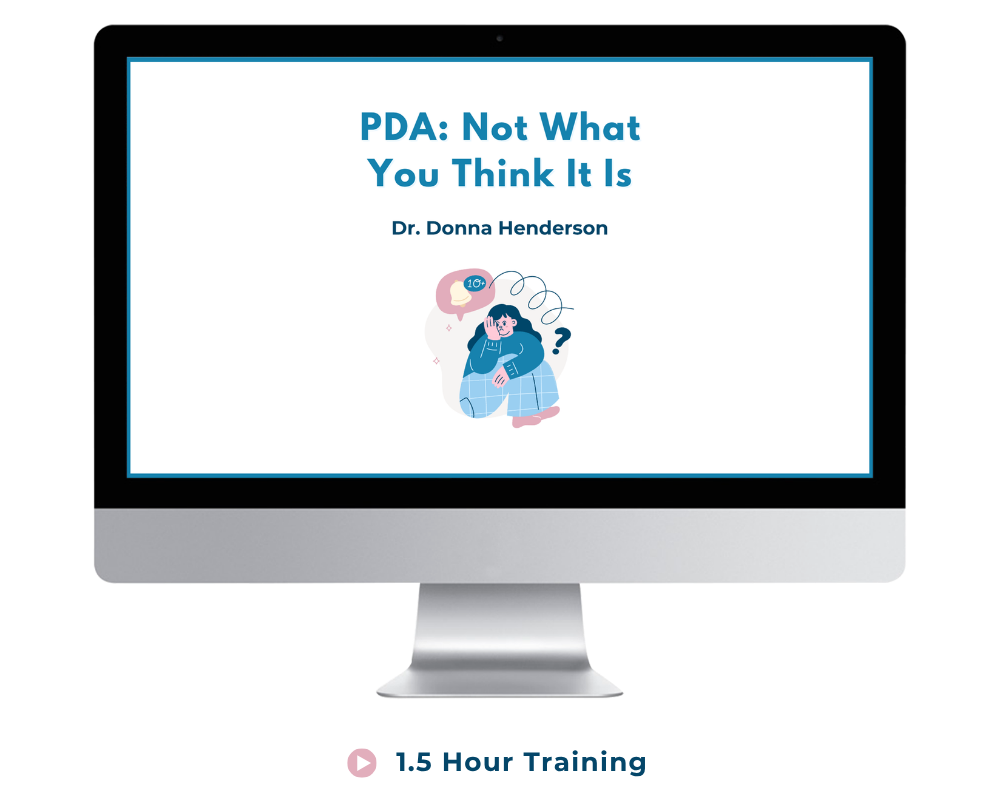
PDA: Not What You Think It Is
Practical strategies for supporting individuals with pathological demand avoidance.
-
1.5 Hours
-
Training Handout
Understanding PDA as a Drive for Autonomy
About This Training
-
Pathological Demand Avoidance (PDA) is drawing growing attention from clinicians and families, yet it remains widely misunderstood and is not a formal diagnosis in the United States. Many children and adults with this profile are misdiagnosed or described as oppositional, and their parents are often blamed. This training reframes PDA as a pervasive drive for autonomy, offering a clearer, more compassionate lens for understanding these clients.
Drawing on years of neuropsychological assessment and detailed case examples, Dr. Donna Henderson walks through the core features of the PDA profile, how it differs from other conditions with overlapping presentations, and how to approach it in diagnosis and reporting. You'll leave with practical, relationship-centered strategies for supporting PDA clients at home, at school, and in the therapy room, along with a closing Q&A with Dr. Neff on common clinical questions.
Training Overview
What You'll Learn
By the end of this training, you will be able to:
-
Describe PDA as a pervasive drive for autonomy and explain why framing it as demand avoidance misses the core of the profile.
-
Identify the six core features of the PDA profile and recognize how they present in children and adults.
-
Distinguish PDA from other conditions with overlapping presentations, such as Oppositional Defiant Disorder (ODD), and describe how to document it in assessment reports.
-
Apply collaborative, low-demand strategies to reduce nervous system activation and support PDA clients, their families, and their schools.
What's Included
Intended Audience
Contents & Materials
Guaranteed Security using one of the most advanced encrypted systems on the market.
The information in this page is being processed and encrypted securely using industry-leading encryption and fraud prevention tools.